Opus, 2003 — X-Mine, NEC and the origins of our vector work
Primary source and corroborating filings for a claim in our stakeholder letter: that we built early vector-embedding language models and named the product Opus.
The primary source
NEC Corporation press release, 10 November 2003, "Launch of Biocompass, a Bio-related
Document Mining Tool." The release originally appeared at
nec.co.jp/press/ja/0311/1004.html; that URL no longer resolves, so the
archived copy is reproduced here in full.
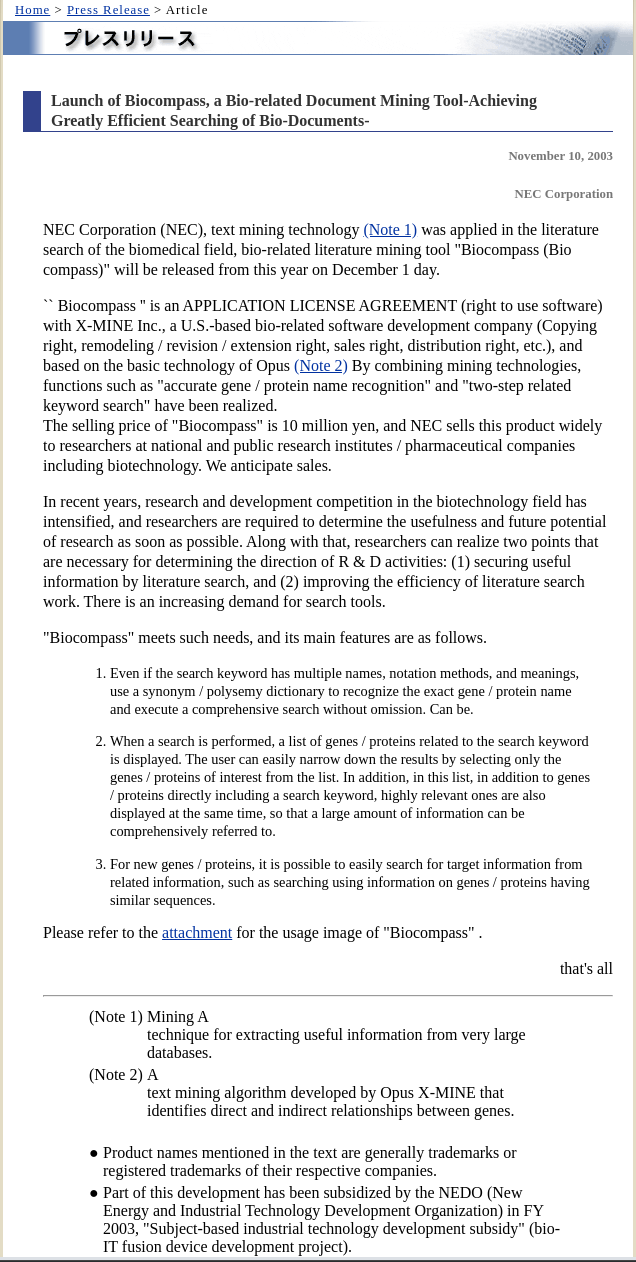
"Biocompass is an APPLICATION LICENSE AGREEMENT (right to use software) with X-MINE Inc., a U.S.-based bio-related software development company … and based on the basic technology of Opus."
"(Note 2) A text mining algorithm developed by Opus X-MINE that identifies direct and indirect relationships between genes."
Corroborating filings and publication
- US2003/0204496A1 — "Inter-term relevance analysis for large libraries." Sandip Ray, Raf Podowski, Kasian Franks. Assignee: X-Mine, Inc. Filed 29 April 2002. View patent
- US 7,987,191 — "System and method for generating a relationship network." Kasian Franks, Cornelia A. Myers, Raf M. Podowski. Priority 6 June 2005, granted 26 July 2011. Claims a network of relationship vectors for what the filing calls "hidden association and connection extraction." View patent
- Peer-reviewed publication — Nakazato T, Takinaka T, Mizuguchi H, Matsuda H, Bono H, Asogawa M. "BioCompass: a novel functional inference tool that utilizes MeSH hierarchy to analyze groups of genes." In Silico Biology 2008;8(1):53–61. PMID 18430990 — NEC's own paper on the product. It documents the tool, not its licensing history.
- Lawrence Berkeley National Laboratory — the same line of work was recognised at Berkeley Lab's 2007 Excellence in Technology Transfer Awards (Today at Berkeley Lab, 13 Dec 2007) and won a 2008 R&D 100 Award as the Biomimetic Search Engine.
Why it matters
Representing entities as vectors and reading the distances between them to surface connections nobody had catalogued is the foundation of modern language models. We were doing it on genes in 2002. We do it on markets now — the same mathematics, pointed at a different corpus. The 2002 filing predates the 2013 word2vec paper that brought the technique into the mainstream by more than a decade.